Old controller is gone
The original controller failed, was removed, or is otherwise unavailable, but a usable controller backup still exists.

Omada already has Site Migration for normal supported online moves. Blackwire Omada Recovery Migrator is for the harder cases: the old controller is unavailable, failed, or cannot participate; only a usable backup remains; the source and destination do not have a workable native path; or the normal migration workflow cannot complete the job.
The current build works from a saved source controller or Fusion configuration together with a fresh backup from the actual destination Fusion. The source controller does not need to be online for the recovery workflow when a usable source backup is available.
Blackwire reviews compatibility, protects destination-owned Fusion state, generates a destination-specific restore, and keeps validation in front of the technician before the file is used on hardware. Beta has not started and there is no public release date.
Where Blackwire fits
If the source controller is online, supported, and able to complete a normal Site Migration, use the native Omada process. Blackwire is being developed for the cases that are left over when that path is not available or not enough.
The original controller failed, was removed, or is otherwise unavailable, but a usable controller backup still exists.
The source and destination combination does not have a native online migration path that can complete the move the way the technician needs.
The technician needs to inspect what can be carried forward, what belongs to the new Fusion, and what needs to be held or handled manually.
The replacement Fusion keeps ownership of its hardware identity, ports, controller login, and other target-specific state while the recoverable source configuration is brought forward.
What it is
Blackwire treats this as a backup-to-destination recovery job, not as a second version of a normal online controller handoff.
The technician loads the saved source controller or Fusion configuration and pairs it with a fresh backup from the actual destination Fusion.
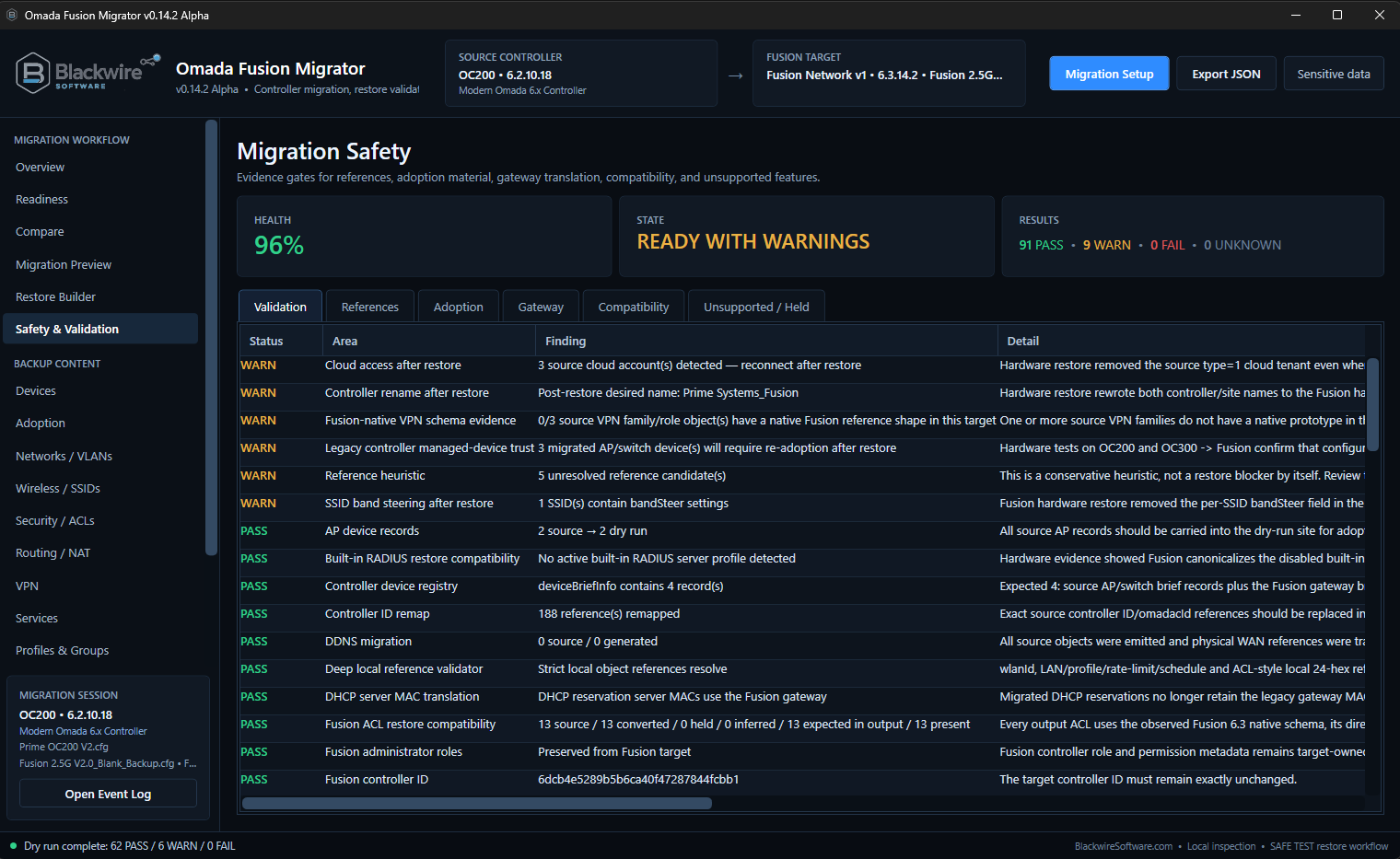
From there, Blackwire reviews compatibility, shows what can be recovered, identifies destination-owned information that must stay with the replacement Fusion, and validates the result before a restore is saved.
This is especially useful when the original controller is no longer available to log into or participate in a live migration. Fusion-to-Fusion recovery and compatibility work is active too, including moves between different Fusion hardware generations.
Hardware-tested recovery results
These results show where the offline/destination-specific approach has survived real Fusion restores. They are combination-specific development results, not a claim that every firmware version, backup, or network design is supported.
| Recovery / migration path | Status | What the hardware test proved |
|---|---|---|
| OC200 V1 → Fusion 2.5G V2-family | Hardware validated | Controller configuration restored successfully from backup. The destination Fusion kept its own hardware identity and local web login. Managed devices still require post-restore trust to be re-established. |
| OC200 V2 → Fusion 2.5G V1-family | Hardware validated | Controller configuration restored successfully with the destination Fusion remaining owner of its hardware identity and local login. Managed devices still require re-adoption/takeover. |
| OC220 6.2.14.12 → Fusion 2.5G V1-family 6.3.14.1 | Hardware validated | A complete OC220 controller configuration restored successfully to Fusion V1-family hardware while preserving destination-owned Fusion identity and login state. |
| OC220 6.2.14.12 → Fusion 2.5G V2-family 6.3.14.2 | Hardware validated | The same complete OC220 source backup also restored successfully to Fusion V2-family hardware with the tested source configuration retained. |
| OC300 6.2.14.11 → Fusion 2.5G V1-family 6.3.14.1 | Hardware validated | Controller configuration restored successfully. The destination Fusion remained owner of its hardware identity and local web login, while managed APs and switches still require post-restore trust to be re-established. |
| OC300 6.2.14.11 → Fusion 2.5G V2-family 6.3.14.2 | Hardware validated | Physical restore testing successfully moved the tested OC300 configuration to Fusion V2-family hardware, including ACL, WAN, VPN, DDNS, routing, and other validated configuration areas. Managed devices still require post-restore re-adoption/takeover. |
| Fusion 2.5G V1-family → V2-family | Hardware validated | Configuration migration between Fusion hardware generations restored successfully. Native post-restore device takeover has also been physically proven in Fusion-to-Fusion testing. |
Hardware Validated
Physical testing has successfully recovered OC200 configurations across both Fusion 2.5G hardware families in the current test program: OC200 V1 → Fusion V2-family and OC200 V2 → Fusion V1-family.
In both tests, the controller configuration restored successfully while the destination Fusion kept ownership of its own hardware identity and local web login. The source OC administrator was not transplanted as the Fusion login.
Existing APs and switches still require post-restore trust to be re-established.
Hardware Validated
Physical testing has successfully recovered a complete OC220 6.2.14.12 controller configuration onto both Fusion 2.5G hardware families in the current test program.
In both tests, the source configuration survived while the destination Fusion retained ownership of its own controller identity, site identity, built-in Fusion gateway, local administrator/IAM state, and Fusion-specific hardware information.
Both generated restores retained those tested configuration counts.
Hardware Validated
Physical testing has successfully recovered an OC300 6.2.14.11 controller configuration onto both Fusion 2.5G hardware families in the current test program.
The tested configuration restored while the destination Fusion remained owner of its own hardware/controller identity, built-in Fusion gateway, local login, and Fusion-specific hardware information. Managed-device trust remains a separate post-restore step.
The hardware-tested restore retained the tested recovered configuration while keeping the Fusion hardware identity intact.
Validation snapshot
The test matrix includes successful restore evidence from OC200, OC220, OC300, both Fusion 2.5G hardware families, and Fusion generation-to-generation recovery/migration.
Current development progress
Coverage is broad now, but it is still conditional. Blackwire is designed to hold or block a setting when it cannot safely represent it on the selected destination instead of silently guessing.
After the restore
Physical testing has shown this same distinction across OC200 → Fusion, OC220 → Fusion, OC300 → Fusion, and Fusion V1 → Fusion V2 work.
In these tests, the network configuration could restore correctly while existing managed APs and switches initially reported that they were managed by another controller.
That points to the device/controller trust and adoption process, not a failed recovery of the network configuration.
The current development direction uses Omada's own adoption process so the replacement Fusion can establish its own device trust after the recovered configuration has been restored.
Fusion-to-Fusion proof testing has already moved test devices from a managed-by-another-controller state into configuring/connected state. Automated OC→Fusion takeover is still waiting on its dedicated physical validation before it is enabled generally.
Destination Fusion safety
That matters even more in a recovery job because the old controller may be gone and the replacement controller has to remain accessible after restore.
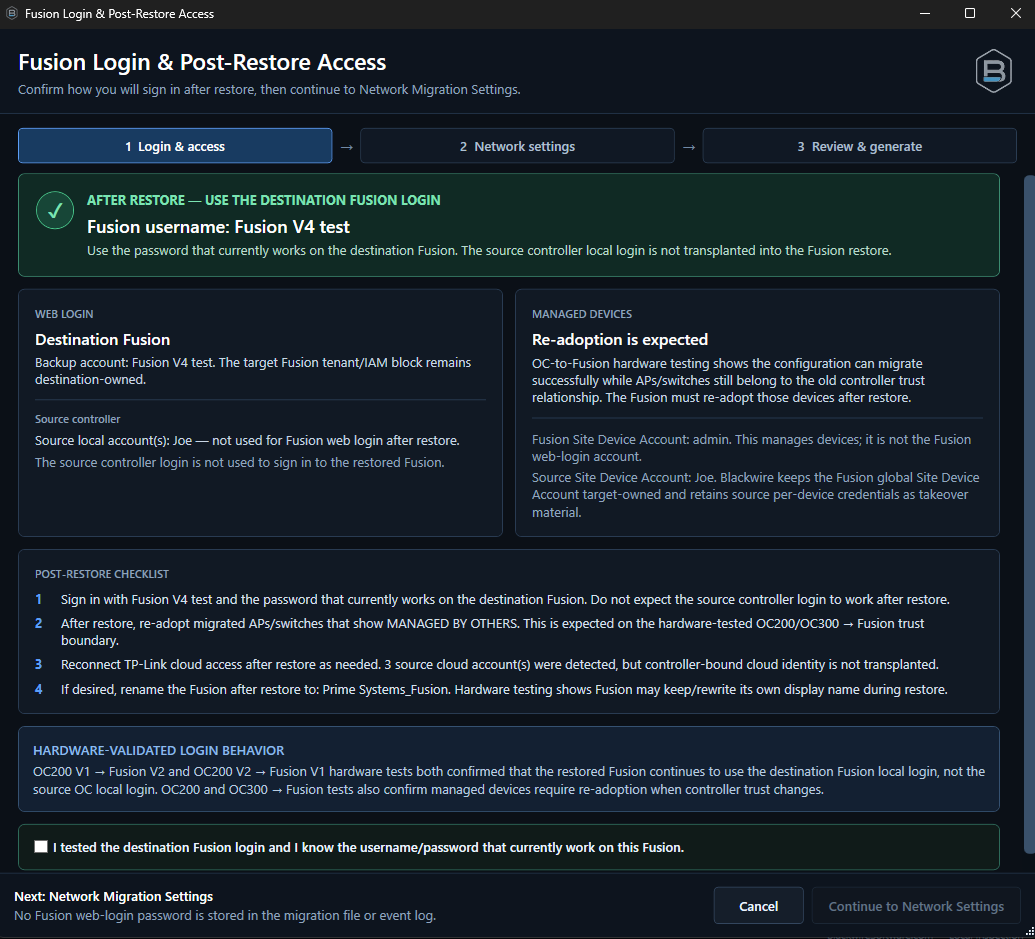
On the tested OC200, OC220, and OC300 → Fusion restores, the destination Fusion continued to use the local web-login credentials that were configured on that Fusion before the recovery.
The source OC controller local administrator is not transplanted as the Fusion web login. The Generate workflow makes the technician verify the destination login before generation so post-restore access is explicit.
Testing has shown that Fusion hardware generations are not interchangeable at the backup level. A fresh backup from the exact destination Fusion gives the recovery the target-specific context it needs.
Blackwire protects destination-owned information such as gateway identity, controller and hardware identity, physical port identity, Fusion-specific capabilities, and the destination administrator/login state.
Generate workflow
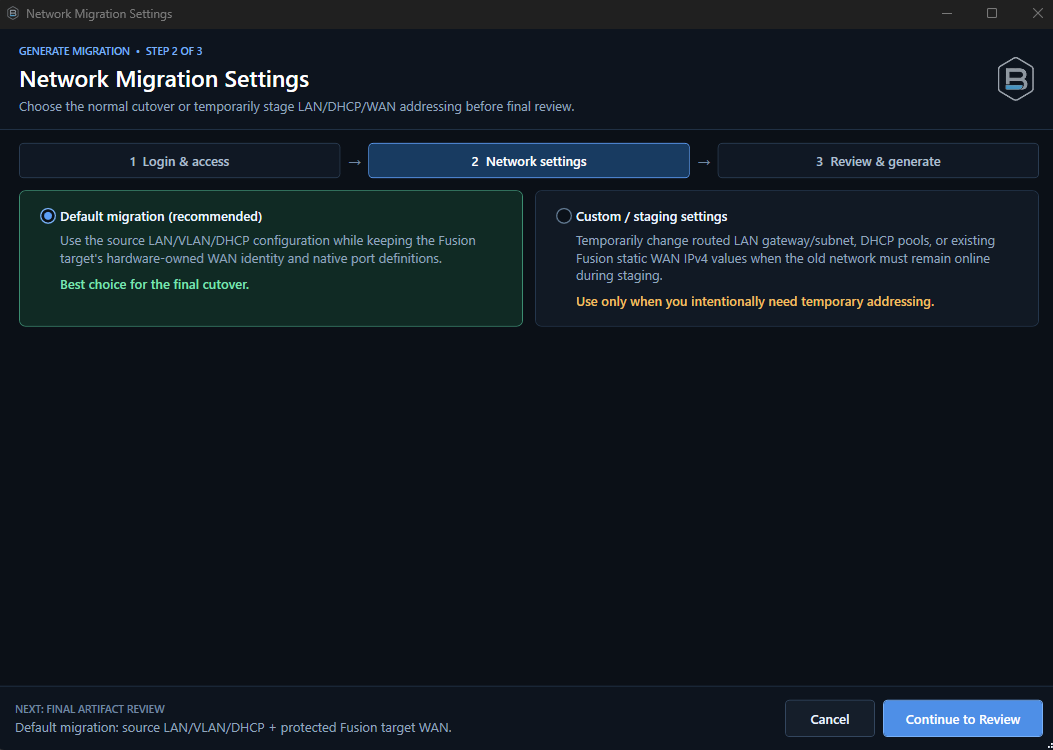
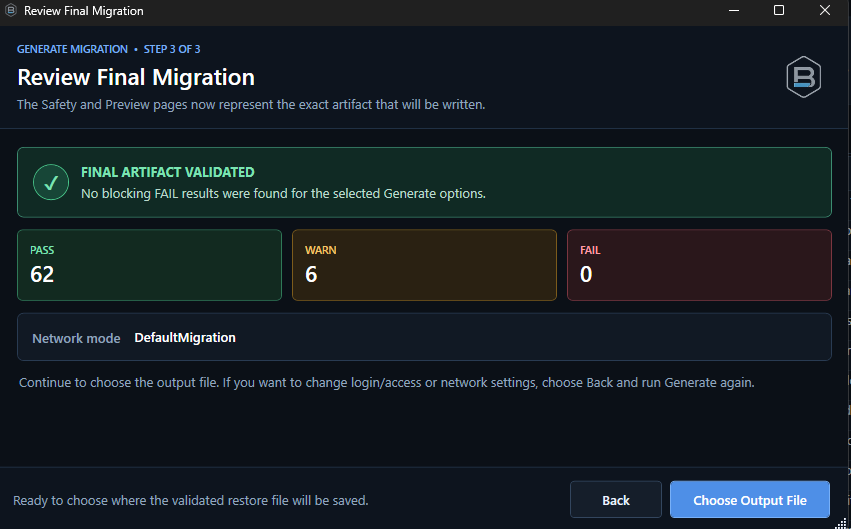
The generation flow is built around problems that matter when rebuilding from backups: post-restore access, network staging, and the exact final artifact that will be applied to the replacement Fusion.
Confirm how the replacement Fusion will be accessed after restore and verify the target-owned login before continuing.
Preserve the recovered addressing by default or intentionally stage temporary LAN, DHCP, or WAN settings when rebuilding around an existing live network.
Review the exact destination-specific artifact and its PASS, WARN, and FAIL results before choosing where the restore file will be saved.
The current flow keeps the final safety result visible until the technician explicitly moves on to save the generated restore.
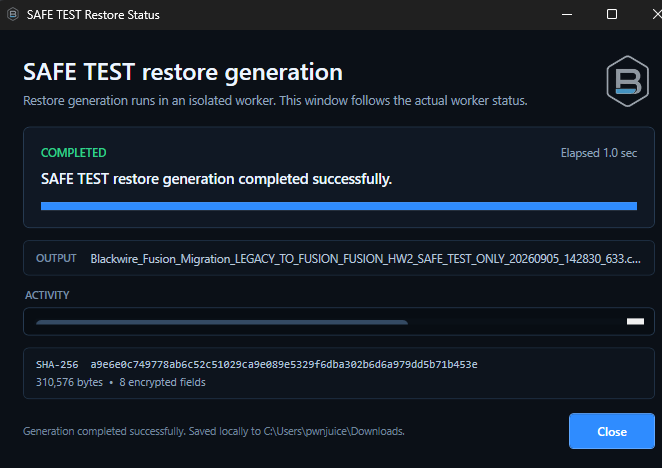
Safety and validation
Recovery from a backup should not mean blindly forcing old configuration onto new hardware. The goal is to stop or flag the job when Blackwire sees something that should not be carried forward without review.
Native Device Takeover
When the old controller is gone, a successful configuration restore can still leave APs and switches trusting the controller that used to manage them.
What we're still testing
Some of the remaining work is about additional controller and firmware combinations; some is about edge cases that show up specifically because the source controller is unavailable or the replacement hardware differs from the source.
Backup and file access
A recovery job often starts with whatever backup is still available, not with a controller that is sitting online waiting for a migration request.
The current Alpha supports local files plus FTP, FTPS, SFTP, and SCP. Secure connection work has also been hardened around certificate and host verification during development.
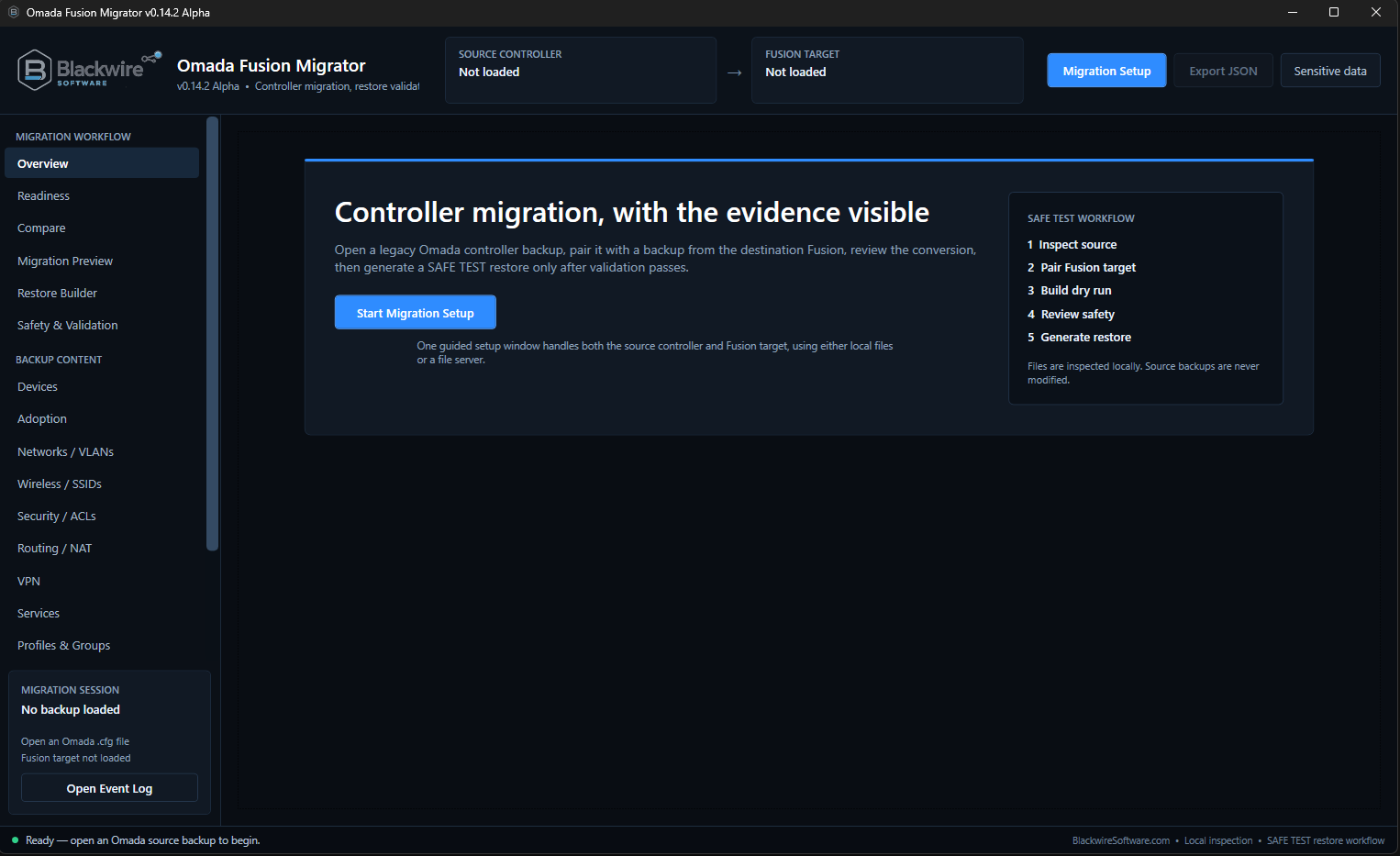
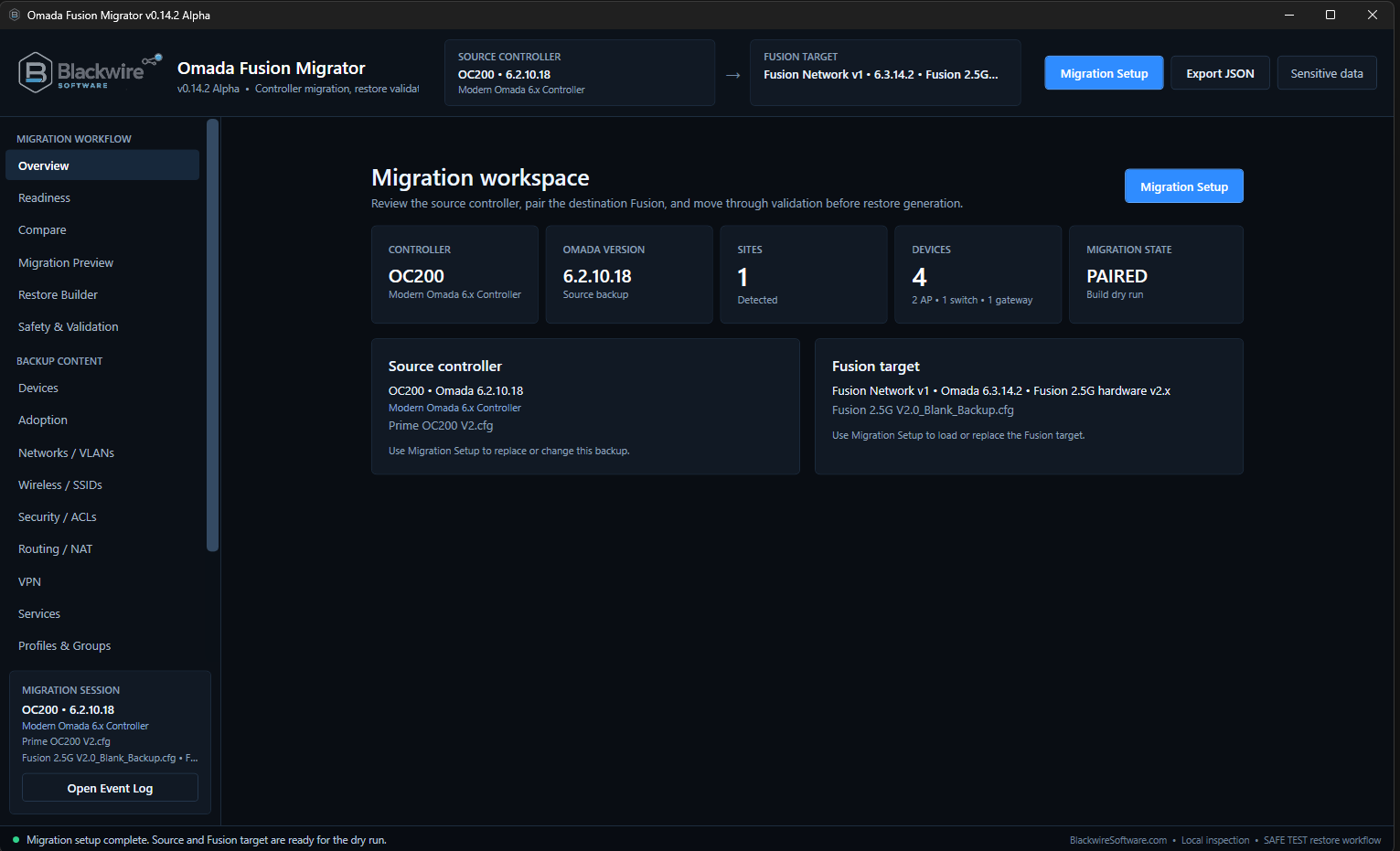
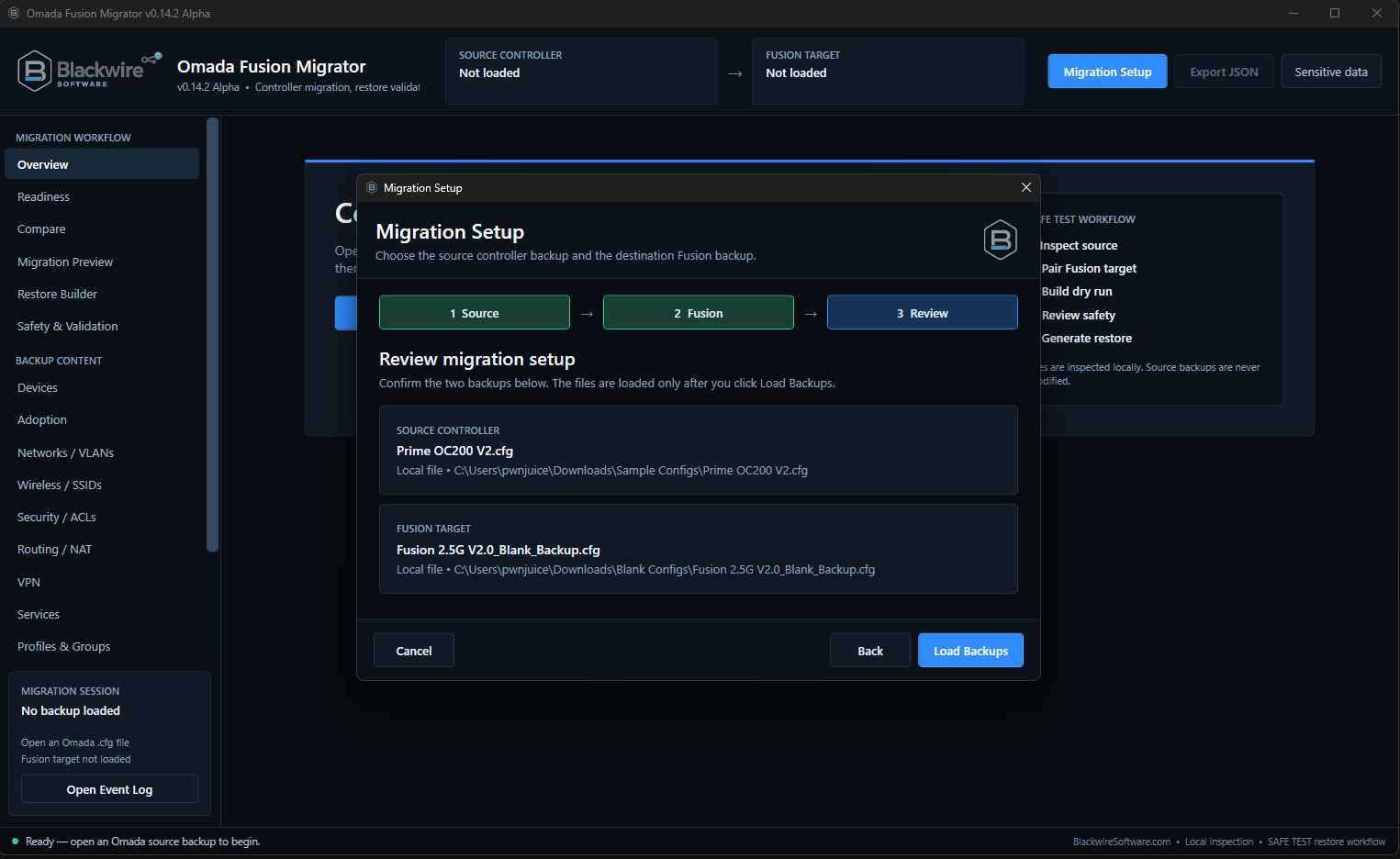
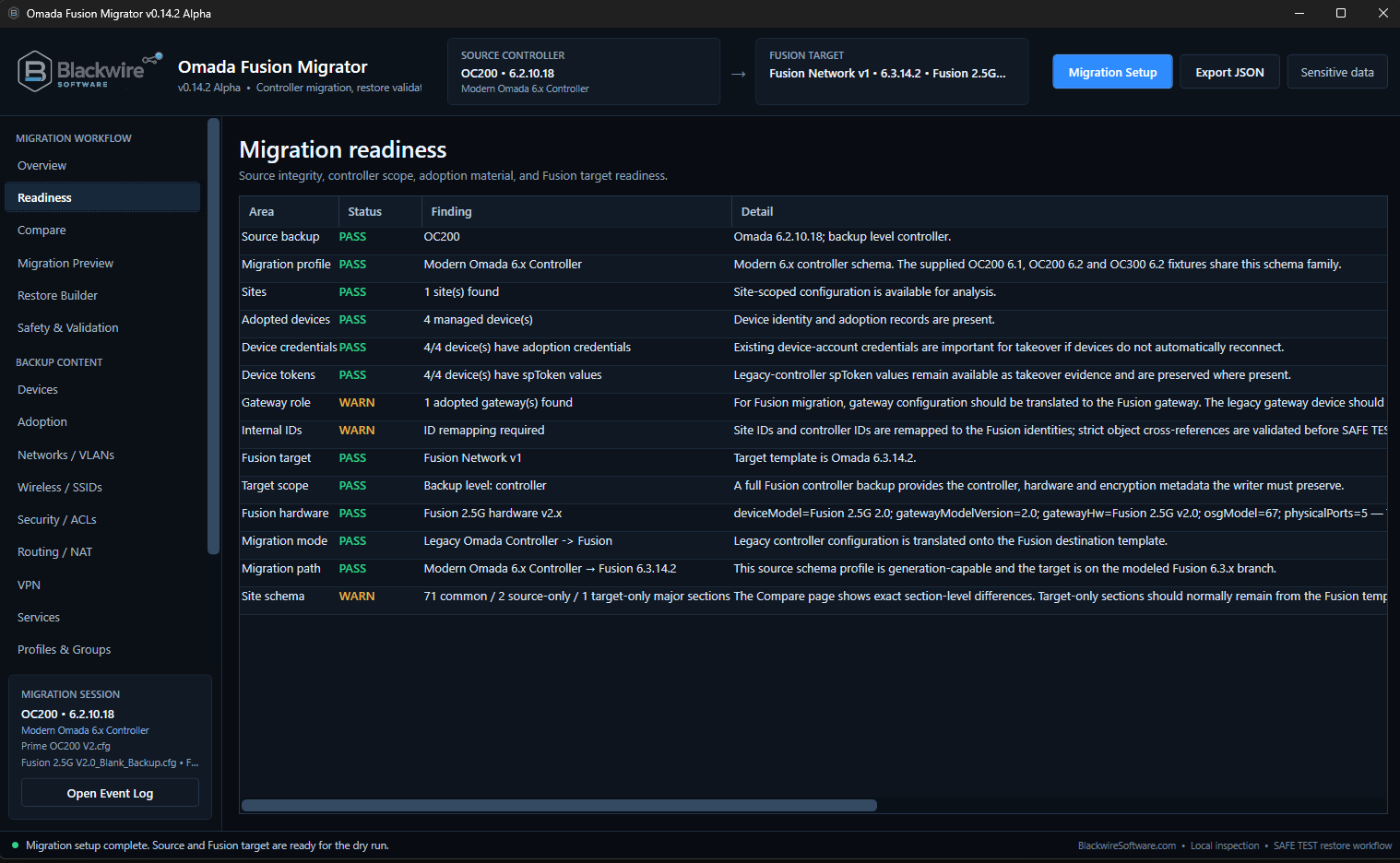
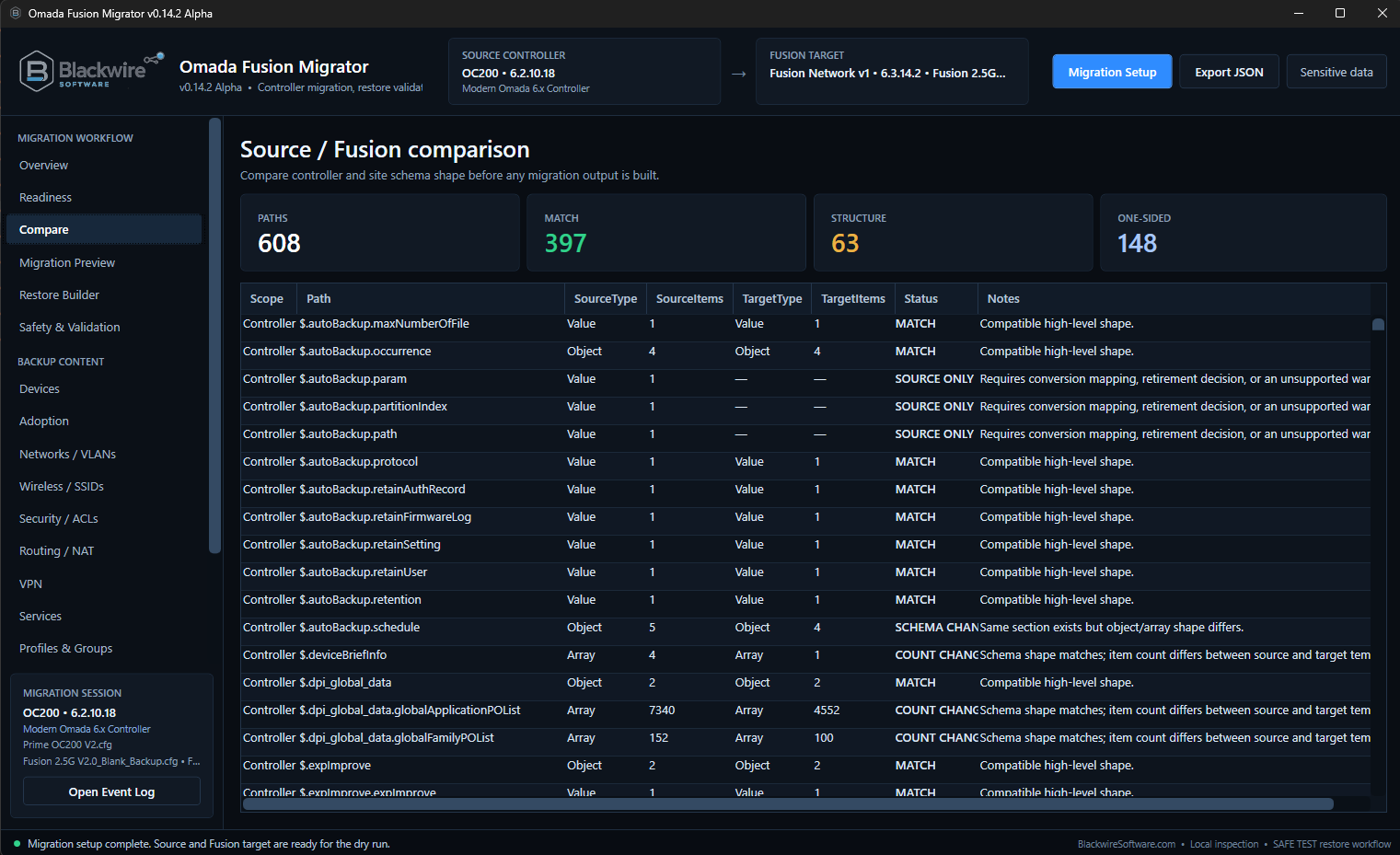
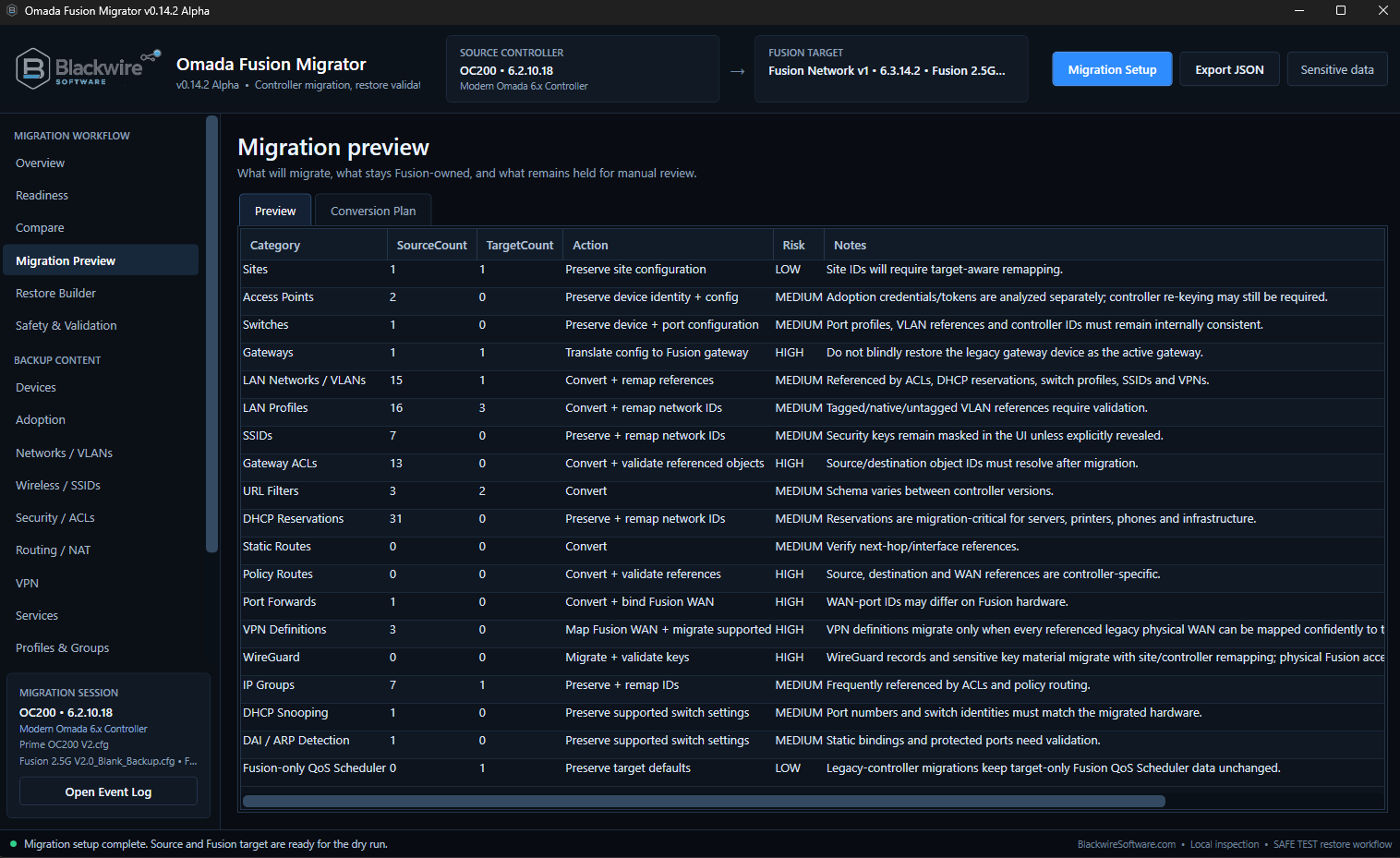
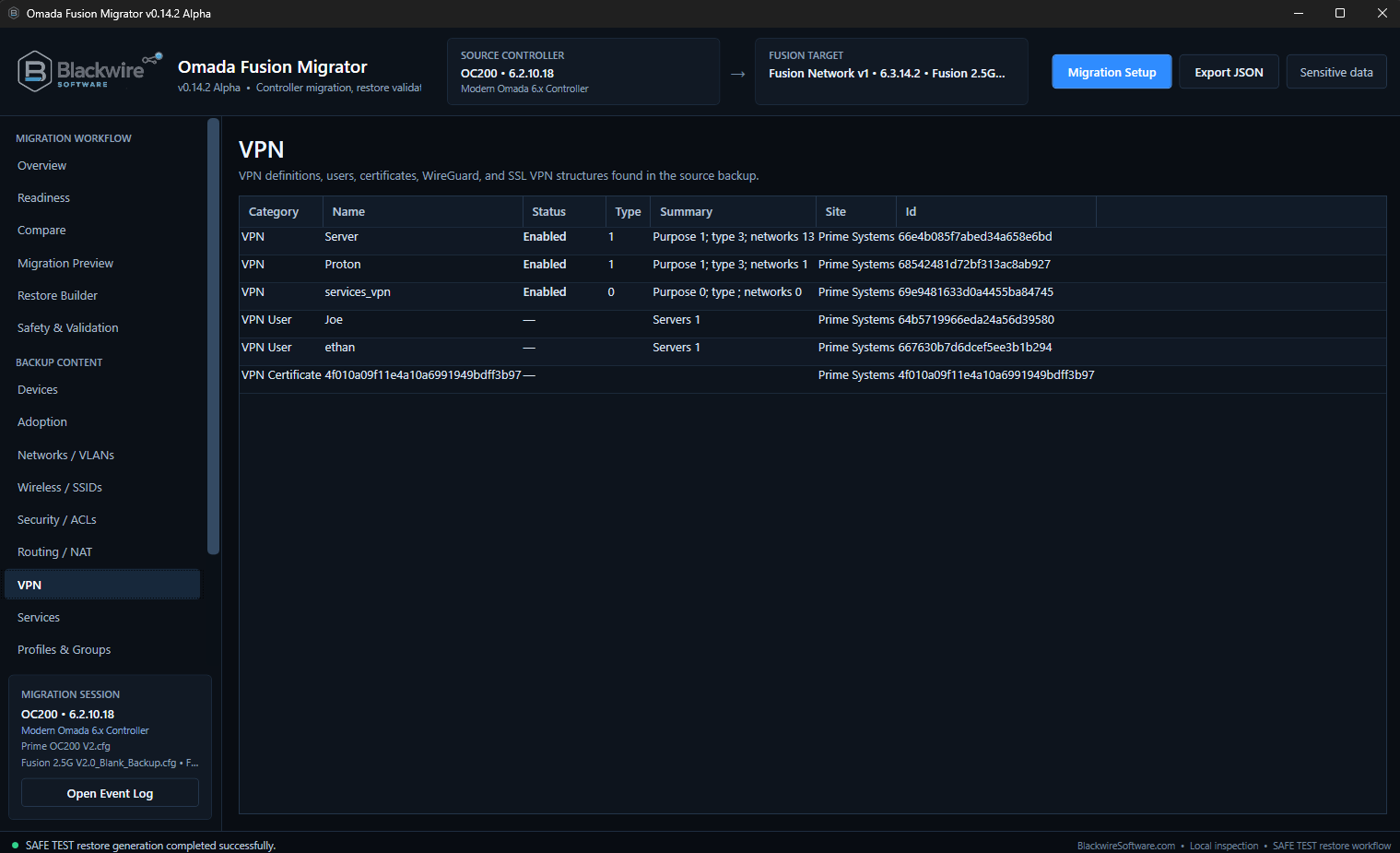
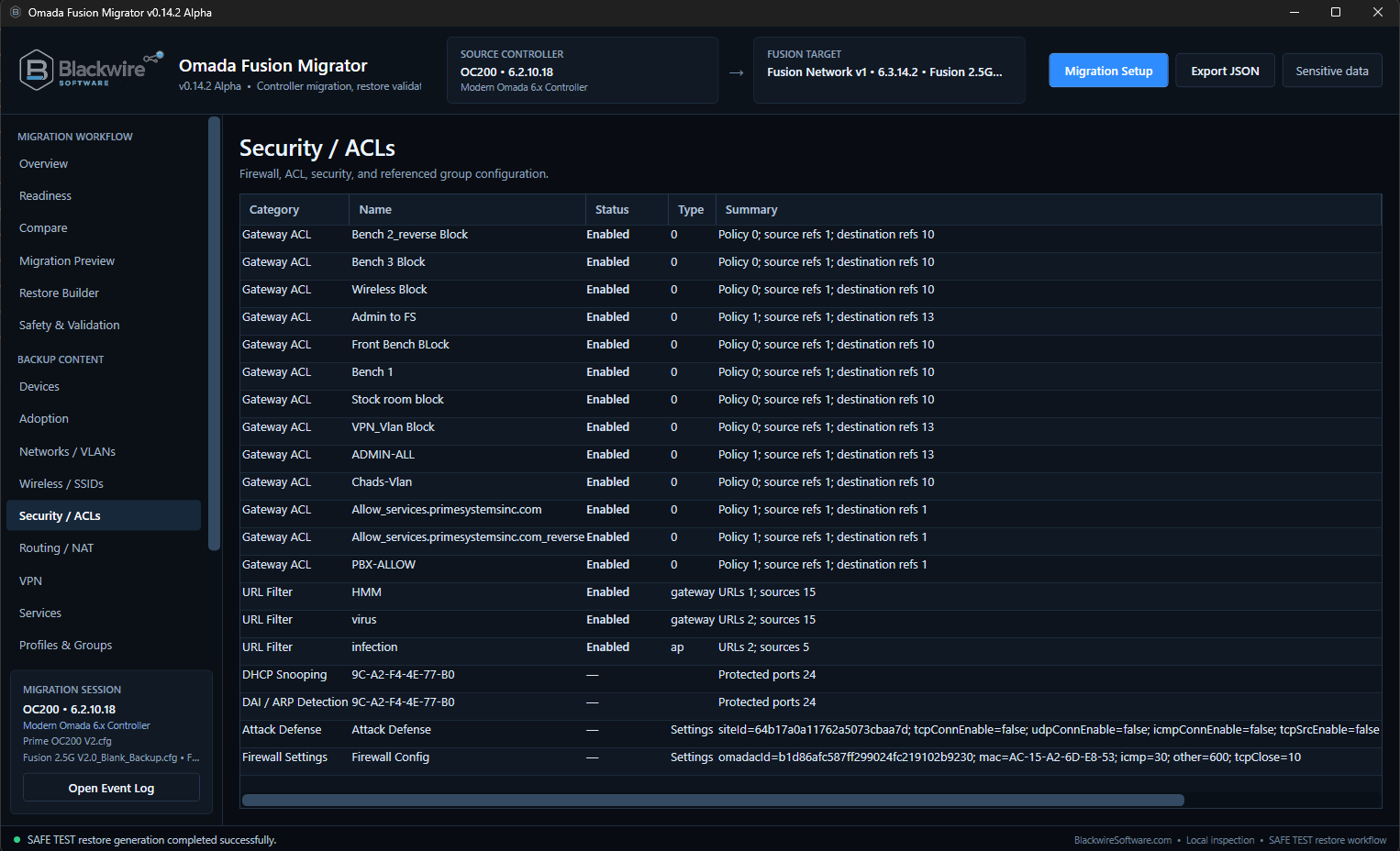
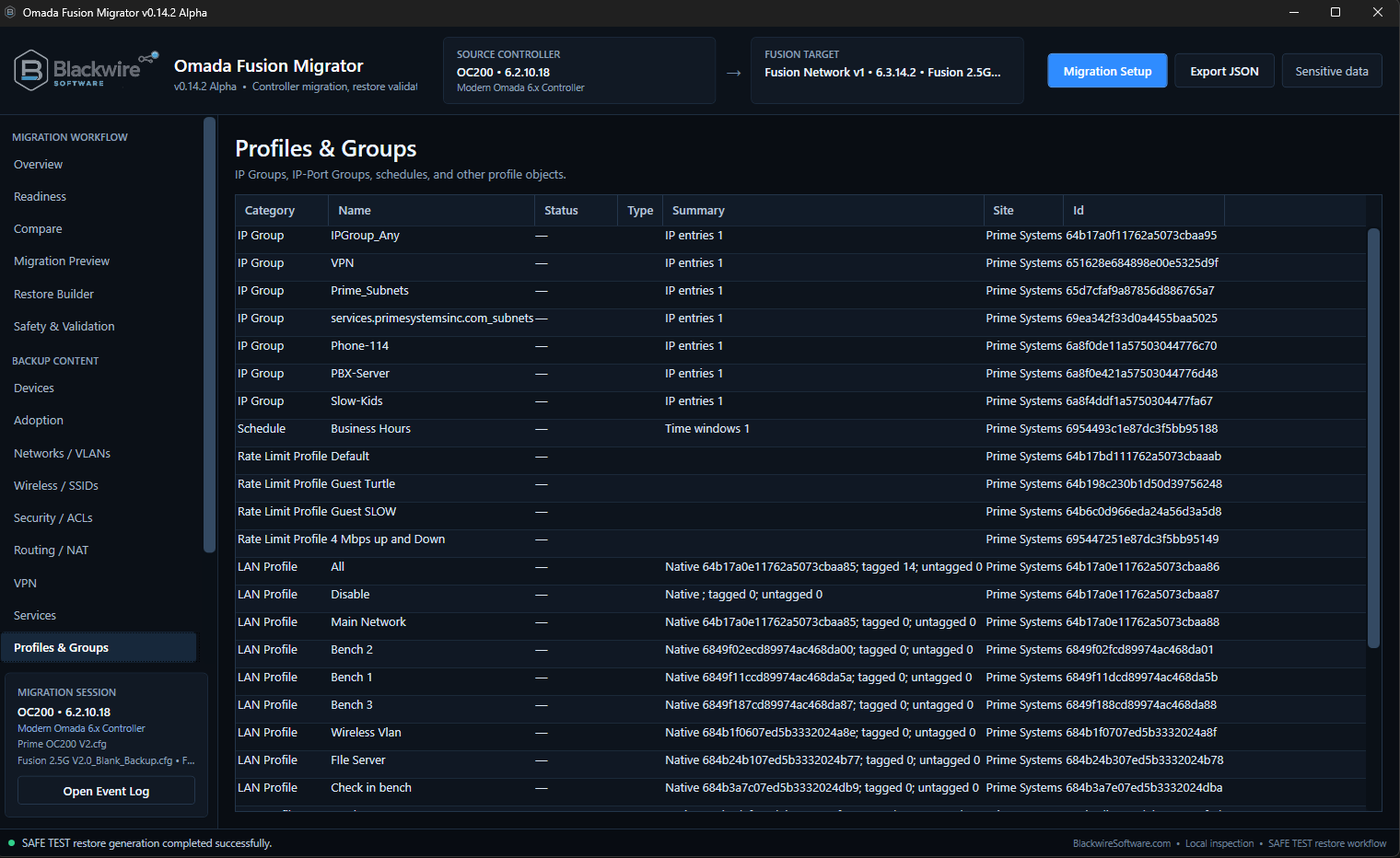
Current build screenshots
They show the offline/recovery workflow as it exists during active hardware testing. Labels, validation results, test environment names, and individual screens may still change before Beta.
These are development captures from real test recoveries and migrations. They show the current review, validation, generation, and post-restore workflow rather than polished release artwork.
The captions explain each screen from the technician's point of view without documenting the internal migration engine.
Late Alpha — Preparing for Beta Testing
The project has gone through major workflow, compatibility, validation, and UI work. Real hardware restore testing is producing repeatable results across OC200, OC220, OC300, both Fusion 2.5G hardware families, and Fusion-to-Fusion recovery/migration.
The next development stage is broader Beta testing with more real-world backups, failed-controller replacement cases, inherited networks, controller/Fusion combinations, and post-restore device scenarios.
Beta has not started yet. There is no public download, pricing, checkout, or announced release date.